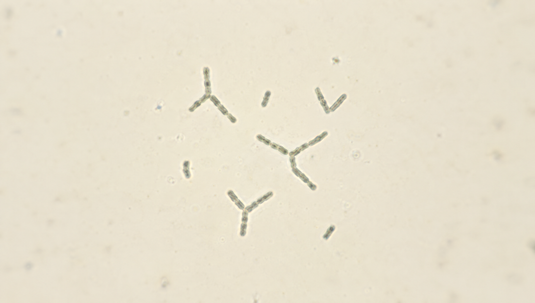
Put a bifidobacterium under a microscope and the first thing you notice is that the cells are not straight. They fork. Irregular rods that split at one end into a Y, or a V, or something closer to a club with two heads. Bacteriologists used to tidy rods and tidy spheres found this strange, and when the genus was finally named in 1924 it was named for the fork. Bifidus is Latin for cleft.
Bifidobacterium longum is one of those forked organisms, and one of the most common bacteria in the adult human large intestine. It was described in 1963 by Gerhard Reuter, out of the same systematic survey of human bifidobacteria that produced several of the other names you will see on a label. Longum means long, after the elongated shape of the cells.
That is the short answer. The longer and more useful one is about the organism sitting right next to it on almost every list, which is where most of the confusion on this subject comes from.
Why "bifidum bacteria longum" is something people type
Roughly a thousand people a month search some combination of Bifidobacterium bifidum and Bifidobacterium longum. That is not carelessness. The two names are easy to collapse: same genus, both common members of the human gut microbiome, both abbreviated to a B. and a word, and both routinely printed on the same label a line apart.
They are different organisms, and the difference between them is one of the more elegant things in gut microbiology.
One of them specializes. The other scavenges.
Bifidobacterium bifidum is built around mucin, the glycoprotein the intestinal lining secretes continuously, whether you have eaten or not. In one well-studied strain, about 60 percent of the organism's sugar-cutting enzymes are predicted to work on mucin-derived sugars (Turroni et al., Frontiers in Microbiology, 2014). It is equipped to live on what the host puts out.
Bifidobacterium longum is built for range. When its genome was sequenced, an unexpectedly large number of its predicted proteins turned out to be devoted to breaking down oligosaccharides, including ones from plant material that people cannot digest themselves (Schell et al., PNAS, 2002). The authors read that breadth as the reason it competes so well where it lives: it can scavenge from a wide variety of sources.
Same genus, same forked cells, two different strategies. If you want to understand why a bacterium cares what you had for lunch, that is where to start, and it is also why the prebiotic side of this subject is not separate from the probiotic side. We have written that vocabulary up at prebiotics, probiotics and postbiotics.
The enzyme that defines the entire genus
Bifidobacteria do not break down sugar the way the lactobacilli beside them on a label do. They run a route called the bifid shunt, and its signature enzyme splits fructose-6-phosphate. The arithmetic changes what comes out the other end: two glucose go in, three acetate and two lactate come out. The output is mostly acetate, where the lactobacilli listed next to it mostly make lactate.
That enzyme is so particular to these organisms that testing for it is a classic way to identify the genus. Not the shape, not the habitat. If a cell has the enzyme, it is a bifidobacterium.
They are also strict anaerobes, not merely oxygen-tolerant, and that one fact explains a great deal about how foods with live cultures have to be made and handled.
What the research on Bifidobacterium longum attaches to
There is a large published literature on Bifidobacterium longum. Almost all of it belongs to named strains rather than to the species, and the strain is the unit that matters. One strain is not another, and a finding about one is not a finding about the next. A label that lists the species and no strain designation is not telling you which organism is in it, and nobody can tell from that label whether the research you read applies.
That is the most useful thing to know before reading anything that promises you a list.
The thing the label is not telling you
Here is the part that surprises people who have been reading labels for years.
Bifidobacterium infantis, which appears on a great many labels as its own organism, has not been its own species since 2008. That year taxonomists showed it sat inside Bifidobacterium longum, and it was reclassified as a subspecies (Mattarelli et al., International Journal of Systematic and Evolutionary Microbiology, 2008). The current name is Bifidobacterium longum subsp. infantis.
So a label listing B. longum and B. infantis on separate lines is listing two subspecies of one species.
That is out of date rather than wrong. It was the valid name for decades, and it is still what most of the trade calls it. But it shows how far behind the shelf the taxonomy runs, and it is worth knowing before you compare one strain count against another.
Questions people actually ask
What is Bifidobacterium longum?
A forked, anaerobic, Gram-positive bacterium of the genus Bifidobacterium, described in 1963, and one of the most common bacteria in the human large intestine. Its first sequenced genome, from a strain isolated from an infant, runs about 2.26 million base pairs at roughly 60 percent GC.
Is B. longum the same as B. bifidum?
No. Same genus, different species, and they feed differently. B. bifidum leans heavily on mucin secreted by the gut lining. B. longum carries the machinery to break down a wide range of complex sugars, including plant material people cannot digest.
Is B. infantis the same as B. longum?
Since 2008, it is classified as a subspecies of it. The full current name is Bifidobacterium longum subsp. infantis. Most labels still print the older name.
Why does the strain designation matter more than the species name?
Because the published work attaches to strains, not species. Two organisms can share a species name, differ by a handful of genes, and behave differently in the tests that have been run. A label that gives you a species and no strain is giving you half the identifier.
Where else does it show up?
In fermented dairy and other foods, as a culture someone added. Unlike the lactobacilli it sits beside on a label, it is not a traditional food-fermentation organism. If it is in a food, a person put it there.
More of this kind of reading is on our science pages.