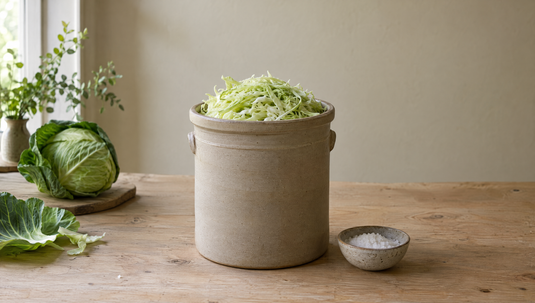
Shred a cabbage, salt it, pack it into a crock and wait. Nobody adds a culture. Within days the jar is sour anyway, because the organisms that do the work were already on the leaves.
When food microbiologists fingerprinted 686 bacterial isolates from commercial sauerkraut fermentations, Lactobacillus plantarum was one of the primary species doing that work (Plengvidhya et al., Applied and Environmental Microbiology, 2007). That is the short answer to what it is: a lactic acid bacterium that lives on plants and turns their sugars into acid. Its name says as much. Plantarum is Latin for "of plants."
The longer answer is about why one bacterium turns up in so many places, and why the name on most labels is no longer its current name.
Named for plants, found almost everywhere
The Danish bacteriologist Sigurd Orla-Jensen first described the organism in 1919, under the name Streptobacterium plantarum. It was later moved into the genus Lactobacillus, which is the name most people know.
The plant connection holds up, but it undersells the organism. L. plantarum turns up on plants, in a wide range of fermented foods, and in people. It is less a specialist of one place than a generalist that does well in many.
A generalist's genome
When the first complete genome of Lactobacillus plantarum was published, it explained that range (Kleerebezem et al., PNAS, 2003). The strain sequenced, WCFS1, came from human saliva, and its chromosome runs about 3.3 million base pairs with 3,052 predicted genes. For comparison, the first Bifidobacterium longum genome came in at about 2.26 million.
A large share of that extra length goes to taking in and using sugars. The genome carries 25 complete sugar transport systems of one major type alone, plus a large number of regulatory genes for switching them on and off. Many of these sit together in a stretch of about 600,000 base pairs that the authors called a lifestyle adaptation region, much of it with a chemical signature suggesting it was acquired from other organisms.
It also keeps two routes for breaking down sugar. Microbiologists call this facultatively heterofermentative: the organism can run classic glycolysis, and it can also run the phosphoketolase pathway, and the genome carries the full set of enzymes for both. That flexibility is a large part of why it can live on a cabbage leaf, in a fermenting crock, and in a human mouth.
Why Lactobacillus plantarum is now Lactiplantibacillus plantarum
In 2020 a group of fifteen taxonomists published a whole-genome analysis of the genus Lactobacillus, which had grown to 261 species, and concluded it was far too diverse to be one genus (Zheng et al., International Journal of Systematic and Evolutionary Microbiology, 2020). They split it into 25 genera.
This organism went to a new genus named for it: Lactiplantibacillus. Its current name is Lactiplantibacillus plantarum. Same organism, same strains, new genus.
The same paper notes that the word "lactobacilli" stays useful as a general term for the whole former genus, which is why you will still see it everywhere. Many labels still print Lactobacillus plantarum. That is out of date rather than wrong, and both names refer to the same species. If you are comparing two labels, it is worth knowing they may be naming the same organism two ways.
The species is not the strain
There is a large published literature on L. plantarum, and almost all of it attaches to named strains. WCFS1 is one strain. There are many others, isolated from different foods and different people, and they differ in which genes they carry. A finding about one strain is not a finding about the species, and a label that names the species without a strain designation is giving you half the identifier.
Questions people actually ask
What is Lactobacillus plantarum?
A Gram-positive, rod-shaped lactic acid bacterium, first described in 1919, and found on plants, in fermented foods and in people. It turns sugars into acid, and its genome carries an unusually wide set of tools for using different sugars.
Is Lactiplantibacillus plantarum the same as Lactobacillus plantarum?
Yes. It is the same species under its current name. The genus Lactobacillus was divided into 25 genera in 2020, and this organism was placed in the new genus Lactiplantibacillus.
Where is L. plantarum found?
On plant material and in many plant fermentations, including sauerkraut, where it is one of the main species involved. It is also found in people: the first strain to have its genome sequenced was originally isolated from human saliva.
Why does the strain matter?
Because the published work attaches to strains, not species. Two strains can share a species name and still differ in which genes they carry.
For the vocabulary around all of this, see prebiotics, probiotics and postbiotics and the gut microbiome. More of this kind of reading is on our science pages.